Design and Custody of Value Systems · Reality made value

REALITY
MADE VALUE.

Starging designs IVS: a governed evidence infrastructure connecting observable production with risk assessment, valuation, and capital decisions for financial institutions, capital providers, and independent validators.

RealityTraceable evidence · Governed decisions
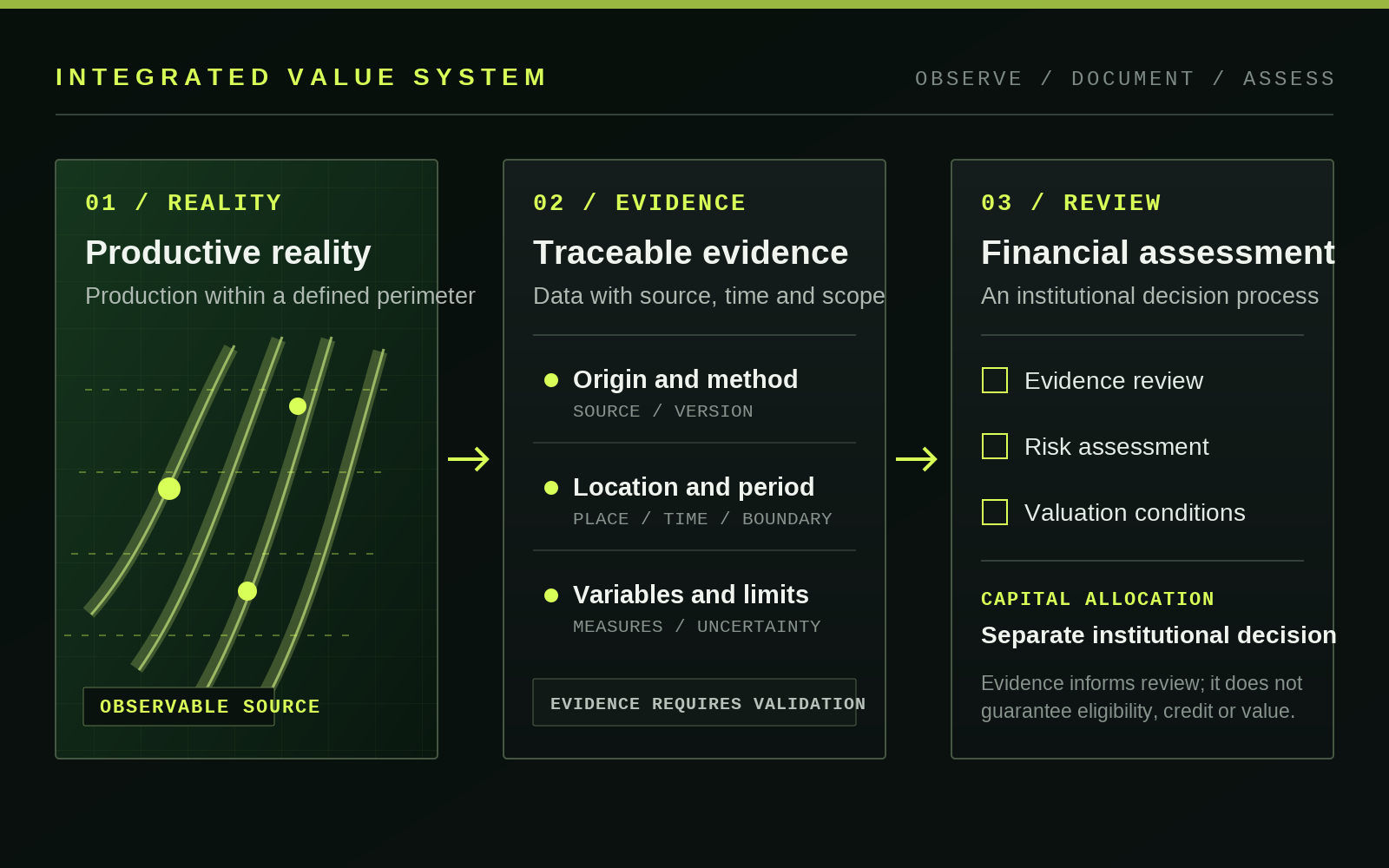
IVS diagram showing productive reality becoming traceable evidence for institutional financial assessment, with capital allocation remaining a separate decision
Institutional identity

What is Starging?

Starging designs and safeguards Integrated Value Systems. Within IVS governance, it defines the protocol conditions under which evidence from observable production may inform valuation and financial processes. This is an internal protocol role, not public regulatory authority, independent validation, or credit approval.

01 · WHAT

System architect and custodian.

Starging is not a bank, investment fund, rating agency, public regulator, or credit approver. It designs the architecture, rules, and custody conditions that connect observable reality with economically admissible value.

02 · ORIGIN

Conceived by Franco Righetti.

Architect of IVSHe conceived Starging as an institutional response to the structural distance between real production, evidence, valuation, and capital.

03 · HEADQUARTERS

Miami, Florida.

United StatesIts headquarters anchors an architecture designed to operate across the Americas and expand progressively worldwide.

04 · PURPOSE

Reducing uncertainty from reality to capital.

Its purpose is to make productive reality observable, evidence traceable, risk more measurable, and value admissible within a governed financial infrastructure.

From reality to capital.

IVS defines a verifiable sequence for observing production, assessing data as evidence, measuring risk, and admitting value within a custody architecture.

01REALITY→
02DATA→
03EVIDENCE→
04RISK→
05VALUATION→
06CAPITAL↗

Choose your institutional path.

Start with the material that fits your role. All initial exchanges can begin in writing.

Capital & financial institutions

Assess the testable financial hypothesis.

Review whether additional traceable evidence can change uncertainty, risk assessment, and financing access for an existing productive asset.

Read the bankability test
Universities & independent validators

Review the evidence architecture.

Examine the IVS layers, data provenance, validation boundaries, and the status of the vineyard demonstrator.

Explore IVS architecture
Technology & implementation partners

Examine the observation-to-evidence path.

Review ATS1 and the proposed controls for traceability, data quality, uncertainty, and human oversight.

See the AI and evidence design

A layered architecture.

Each layer performs a defined function. Admissibility membranes coordinate the transfer of information, value, and responsibility between them.

Layer 0 · Economic perimeter

Reality before its representation.

Defines what exists, what can be observed, and the scope within which production enters the economic system.

Representation.
Monetary continuity.

Within IVS, DRT and DDV perform complementary functions. Evidence may support an eligibility review; monetary consequences require their own documented authorization.

DRT · Dynamic Reality Token

A traceable representation.

A DRT identifies what it represents: a productive state, an identified right, or a contractual commitment. It records evidence, uncertainty, permitted uses, event history, and any available valuation. Each material update identifies its cause: a physical event, new evidence, a correction, or a change in rights, models, or rules.

SCIENC3S is responsible for DRT within the architecture. Scientific validation remains distinct from financial decision-making. A versioned registry demonstrator does not by itself establish an implemented cryptographic token, transferability, or legal ownership.

DDV · Living Digital Money

A defined monetary function.

DDV is designed as a renewable monetary system that aims for continuity and universal access. Its design requires explicit obligations and holder rights, eligible and assignable backing, liquidity, rules for absorbing losses, and authorized custody responses.

Economics Trends is responsible for DDV from C2 through C4: backing eligibility and allocation, financial assessment, liquidity, and systemic limits. Creating or updating a DRT does not create money, approve credit, or provide payment resources.

Direction, integration, and audit. Starging maintains the architecture and interfaces, coordinates responsibilities, and oversees auditing across the system, with separation from the decisions being reviewed. Independent validation requires a third party free from relevant conflicts of interest.

Observable reality · Verifiable value

Reality takes economic form.

Observation converts physical production into measurable evidence; evidence reduces uncertainty and enables admissible valuation.

AI supports analysis. Governance remains accountable.

Within IVS, artificial intelligence is designed as an analytical aid across the evidence chain, with provenance and uncertainty carried into human review.

Designed AI role · not a deployment claim

Improve the quality and interpretation of evidence.

AI may assist with data-quality checks, anomaly detection, evidence classification, and uncertainty estimation across observation periods. Each output should retain its source inputs, model and version, transformations, confidence limits, and review history.

Decision boundary

Human and institutional responsibility.

AI outputs inform review; they do not independently admit economic value, create or issue DDV, certify evidence, or approve credit. Independent validation and financial decisions remain with the responsible institutions.

Current status. This describes the intended design role for AI in IVS. It does not claim that a production AI model is currently deployed or independently validated.

Designed for scale. Built for progressive bankability.

The architecture has a twenty-year deployment horizon. Initial structuring capital is intended to build the institutional and technical capacity needed to pursue financing in successive stages.

US$60MTarget global structuring capital
20 yearsDeployment horizon
1B devicesLong-term digital twin target

These figures describe planning targets, not capital raised, financing committed, or devices deployed.

Economic admissibility demonstrator

Testing the path from an observable crop to a financeable asset.

The vineyard demonstrator illustrates how soil, vigor, and canopy observations could inform assessments of uncertainty, risk, and value for a standing crop. The standing crop is the proposed asset; the land is outside the valuation scope.

Demonstrator scope. The images are illustrative and the data are synthetic. This demonstrator defines a test frame; it does not report field measurements. Valuation and financing eligibility are assessed for each asset using independently verifiable evidence and the institution’s criteria.

Observation points
Malbec vine showing canopy, grape clusters, trunk, and soil roots
TARGET RESOLUTION: 10 MILLUSTRATIVE MODEL

Validation is specific to each case.

The process depends on the asset, available evidence, scope, and applicable institutional criteria. Each assessment is documented for its own case; a single public status would not represent materially different cases.

01 · ArchitectureDefined

IVS layers, responsibilities, and admissibility boundaries are described on this site.

02 · DemonstratorIllustrative · synthetic data

The vineyard model is a test frame; its images and current presentation do not establish field measurements.

03 · ValidationAssessed case by case

Each assessment is scoped to the asset, available evidence, and applicable validation criteria. Findings are recorded for that case, not summarized as a general status.

Protocol authority for economic admissibility

Within IVS governance, Starging defines the protocol conditions under which evidence may be admitted.

This is not an independent valuation or a public regulatory decision. Independent validation and each financing decision remain with the responsible institutions.

Franco RighettiArchitect of Integrated Value Systems

Documents & written institutional exchange.

Review the IVS test proposal and EVO financial framework, or begin a written institutional exchange with Franco Righetti on LinkedIn. The source documents listed below are currently in English.

Bankability test proposal · English

From Observable Reality to Bankable Evidence

A testable hypothesis for assessing whether additional traceable evidence changes uncertainty, risk, and access to financing for an existing productive asset. It proposes a test, not an investment, and does not assume a positive outcome.

PDF · English · 1 page · Signed 2 October 2026
Financial framework · English

Economics of Observable Value

The financial edition translates EVO’s formal framework into risk management, capital markets, and prudential regulation.

Download financial editionPDF · English · 36 pages
Continue on LinkedIn

Follow the work. Join the exchange.

Use LinkedIn to begin written institutional correspondence about Starging, IVS, observable value, or supporting documentation.

Start a written exchange

Franco Righetti
Architect of Integrated Value Systems